
White-Labeled Injectables & Unapproved Sourcing
What the 2026 FDA warning letters mean for med spas, aesthetic RNs, NPs, PAs and medical directors.
Cindi Vokey, BSN, RN, LNC · Sources Reviewed November 2026
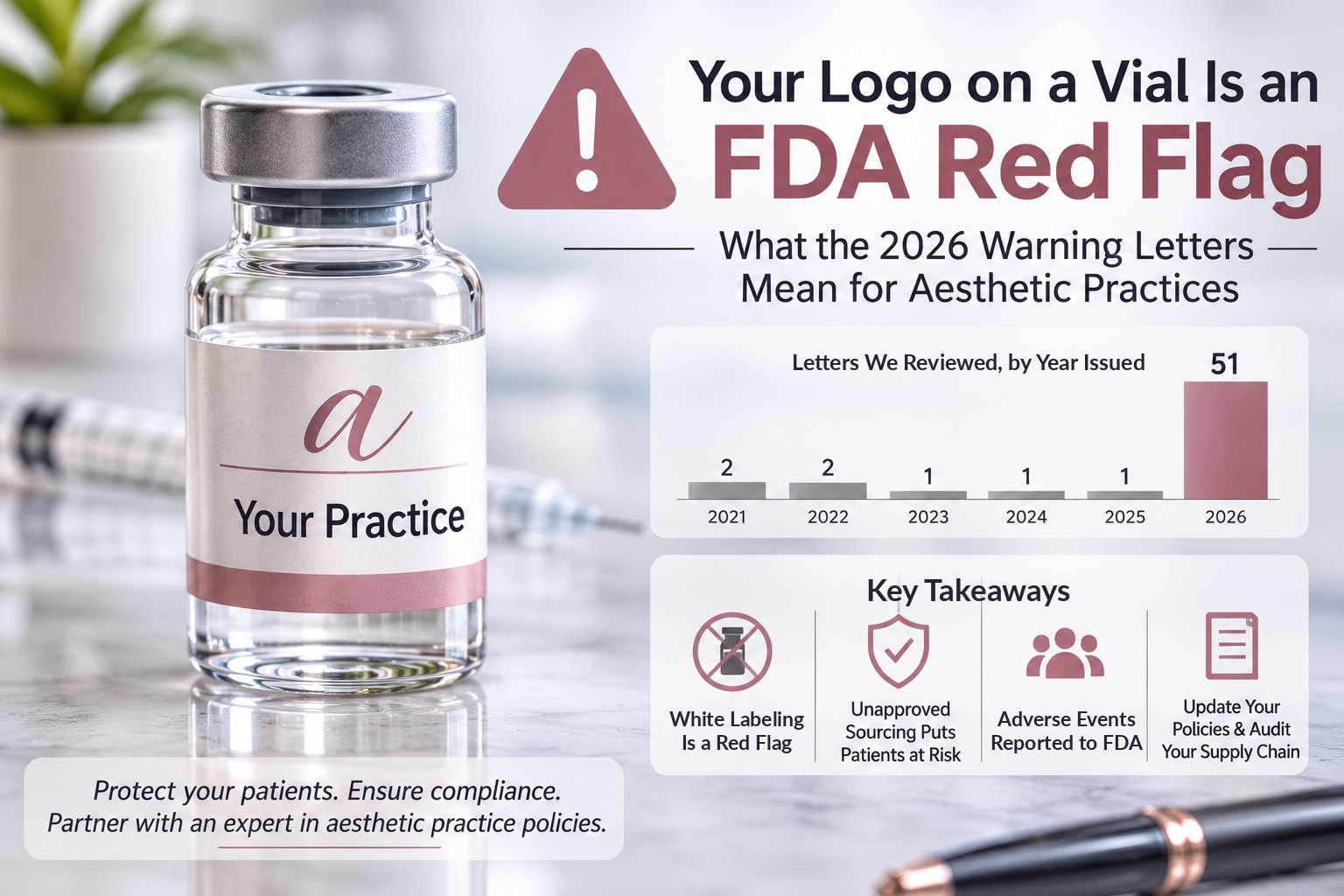
FDA Enforcement Is Ongoing. The Primary Issue Is Improper Vendor Sourcing. Can Your Website Prove Your Sourcing Is Correct?
FDA issued 51 warning letters to telehealth, IV and aesthetic businesses in two 2026 sweeps, and letters were still being posted in November. A recurring finding: a seller's own brand on compounded injectables it did not make. FDA found these violations through websites, product photos and social media, often with no inspection.
Company, practice and individual names from the FDA letters have been removed. The goal is awareness and prevention.
What 58 Warning Letters Show
Of 58 letters reviewed, 51 were issued in 2026 under FDA's subject "False & Misleading Claims/Misbranded (Telehealth)." The other seven, from 2021 to 2025, went to internet pharmacies and unapproved-drug websites.
| Feb 20 | GLP-1 telehealth and med spa sweep | 30 |
| Mar 31 | "Research use only" peptide seller | 1 |
| Apr 1 | First DSCSA letter to a med spa | 1 |
| Jun 8 | Second GLP-1 sweep, incl. a medical spa | 21 |
| Aug 24 | Five "research use only" peptide vendors | 5 |
| Nov 3 | Telehealth company, website and X review | 1 |
Why a Practice Name on a Vial Is a Red Flag
A compliant compounded injectable is labeled by the pharmacy or outsourcing facility that made it, not the practice that buys it. FDA reads a practice logo on a vial as a claim about who manufactured the drug.
Why Legitimate Compounders Do Not White Label
A 503A pharmacy compounds for an individual patient and labels with its name and that patient's. A 503B outsourcing facility is FDA-registered and must identify itself on the label. A supplier willing to print your logo is operating outside both pathways.
What the Regulator Sees
Websites, product photos, pinned posts and bios. A branded-vial photo on Instagram is evidence. Every letter requires a written response within 15 business days (FDA).
Where the Drugs Come From
FDA now holds the practice that injects a drug responsible for its source. If you cannot document an authorized source, the product is presumed suspect.
Sterile compounding requires a classified cleanroom, not a bench top. A white-labeled vial gives no way to know where it was made.
What These Products Do to Patients
When the label names the practice instead of the maker, you cannot trace a recall, confirm concentration or report an adverse event to the right firm.
Six Questions to Ask Your Practice Today
- 01Does every vial we administer show the name of the pharmacy or outsourcing facility that made it, or does it show our name?
- 02Can we name, today, the licensed pharmacy or registered outsourcing facility behind every compounded product we use, and verify that licensure?
- 03Are our product photos, social posts and sales pages free of "generic," "same as," "same active ingredient" and "FDA-approved pharmacy" language?
- 04Are we ordering anything labeled "Research Use Only" or "not for human consumption" for patient use?
- 05Does our medical director know exactly where our compounded products come from?
- 06Do our policies and procedures include a written vendor-verification and product-sourcing process, and is our team actually following it?
If any answer gives you pause, fix it now, before FDA, your state Board or a patient complaint asks for you.
For Providers and Practice Owners
- Buy FDA-approved products only from the manufacturer or an authorized distributor; keep invoices.
- Verify compounders are a licensed 503A pharmacy or FDA-registered 503B facility; keep it on file.
- Never buy RUO peptides, overseas website product or deeply discounted product.
- Reconcile units purchased against units administered monthly.
- Accept only vials naming the maker; refuse your logo on any injectable.
- Keep products in original labeled packaging; no unlabeled or decanted vials.
- Remove "FDA-approved," "generic," "same as" and "clinically proven" claims for compounded products.
- Delete photos showing your brand on a vial, including pinned posts and old reels.
- State that compounded drugs are not FDA-approved and are prescribed after an individual evaluation.
- Add sourcing, quarantine, recall and adverse event (MedWatch) procedures to your P&P manual.
- Document each patient-specific evaluation and dosing teaching.
- Name who responds to a Form 483 or warning letter within 15 business days.
Check Your Supply Chain Before a Regulator Does
Can you name the maker behind every product you inject? Book a free 30-minute consult or take the two-minute practice overview.

Peptides & Practice
FDA and state regulations, how to identify proper sources and the consequences of improper peptides.
- 2 Contact Hours
- California BRN Provider #18009
- Online, Self-Paced
Educational information only, not legal advice. Reviewed November 2026. Review your sourcing, labeling and marketing with a healthcare attorney licensed in your state.
Sources
- FDA: FDA Warns 30 Telehealth Companies Against Illegal Marketing of Compounded GLP-1s
- FDA: What to Know When Promoting Compounded Drugs
- FDA: Warning Letters
- Foley & Lardner: FDA Targets Telehealth Marketing in 30 New Warning Letters
- Polsinelli: Medspas on Alert, the FDA Says You're a Dispenser Too
- ArentFox Schiff: Research Use Only Is Not a Legal Strategy
- Modern Aesthetics: FDA Warns Websites Selling Unapproved Botulinum Toxin
- Live Science: Fake Botox Injections Sickened 22, Hospitalized 11 (CDC)
- FDA Alert on Compounded Semaglutide Dosing Errors, July 29, 2024
- KSL: Poison Center Calls for Injected Semaglutide
- Partnership for Safe Medicines: New York Med Spa Inspections