
FDA Is Reading Your Website and Your Social Media
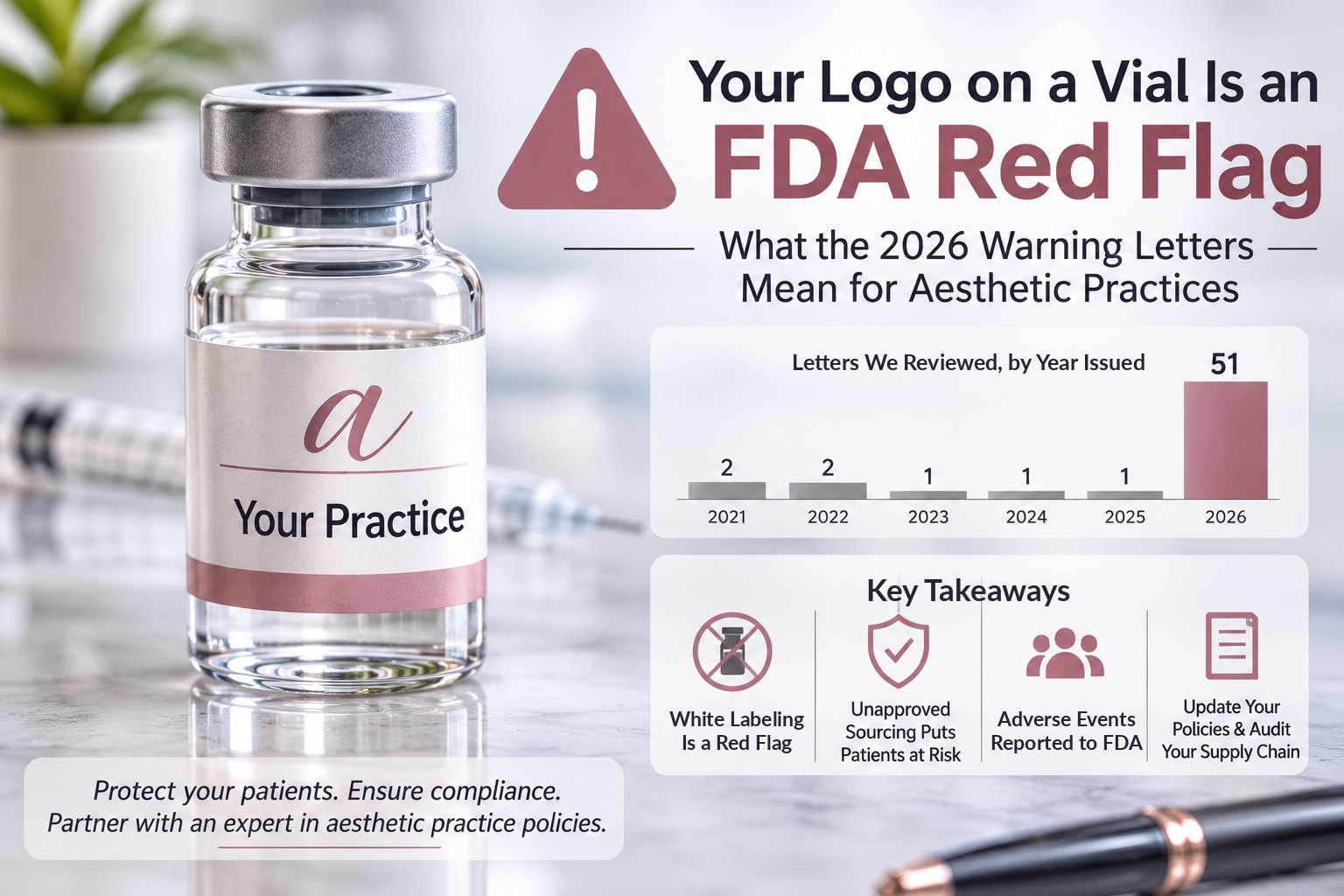
Between February and November 2026, FDA's Center for Drug Evaluation and Research issued more than 50 warning letters to telehealth companies, med spas, IV and aesthetic practices, and weight-loss clinics over how they marketed compounded semaglutide and tirzepatide. In March 2026 alone, FDA announced 30 warning letters to telehealth companies in a single day. This enforcement is ongoing.
None of these letters started with an inspection of a clinic. They started with a website review. FDA looked at product photos, vial images, sales pages and promotional claims, then wrote to the business.
Several of the recipients were not large telehealth brands. They were local medical spas and aesthetic practices that looked a lot like many of the practices we work with every day.
The Red Flag: Your Name on the Label
The most common problem in these letters was simple. The clinic's own name or logo appeared on the vial label in its website photos.
In one letter to a medical spa, FDA wrote that the compounded semaglutide and tirzepatide products on the website "identify [the practice] on the pictured label, suggesting [the practice] is the compounder of those drugs when in fact it is not." The same language appears in letters to other aesthetic practices and telehealth companies.
FDA's reasoning comes from a long-standing labeling rule, 21 CFR 201.1(h)(2). When a name appears on a drug label without qualification, it tells the reader that the named business is the sole manufacturer. If that business did not make the drug, the label is false and misleading, and the drug is misbranded under sections 502(a) and 502(bb) of the Federal Food, Drug, and Cosmetic Act.
This is what "white labeling" means in practice. A product is made somewhere else, and the clinic's brand goes on the vial. FDA's own guidance to telehealth companies now lists "using branding on their website that falsely or misleadingly implies the telehealth company is the compounder" as a specific false or misleading claim. FDA's press announcement described it as "obscuring product sourcing."
Why White Labeling Points to an Unapproved Supply Chain
Compounding pharmacies and outsourcing facilities that follow federal and state requirements do not put your clinic's name on their products. A legitimate compounded drug's label identifies who actually made it.
So when a vial shows a med spa's logo instead of a pharmacy, it raises questions FDA now asks directly. In each of these letters, FDA asked the practice to:
- Identify the entities that actually produce the compounded drugs offered on its website.
- Provide a representative sample of the product labeling.
- Correct or remove any other false or misleading claims.
Practices had 15 working days to respond.
If your practice cannot answer the first question quickly, with the name of a properly licensed pharmacy or registered outsourcing facility, that is your answer about your supply chain.
Receiving the Product Is Also a Violation
This is the point many providers miss. The letters do not only address the business that sells or ships misbranded drugs. FDA reminded every recipient that "the receipt in interstate commerce of misbranded drugs, and the delivery or proffered delivery thereof," is also a prohibited act under section 301(c).
A clinic that orders white-labeled or misbranded product, accepts delivery and administers it to patients is not standing on the sidelines.
The Other Claims FDA Flagged
Alongside branded vials, the letters repeatedly cited marketing language that many aesthetic websites still use:
- Calling a compounded drug a "generic" version of a brand-name product. Generic drugs are FDA-approved. Compounded drugs are not.
- Saying a compounded drug has the "same active ingredient" as a brand-name drug, which FDA said implies the product has been approved or evaluated for safety and effectiveness.
- Saying products come from an "FDA-approved" or "FDA-licensed" pharmacy or outsourcing facility. FDA stated plainly that it does not approve or license compounding facilities, and that outsourcing-facility registration is not FDA approval.
A separate letter went to an online peptide seller whose tirzepatide and retatrutide vials were labeled "Research Use Only" and "not intended for human consumption." FDA found the products were unapproved new drugs anyway, because the website showed they were intended for human use. A "research" label does not change what a product is when it is being sold for patients.
This Is a Patient Safety Issue First
Labeling rules can sound like paperwork. They are not. FDA's page on concerns with unapproved GLP-1 drugs describes what happens when the supply chain breaks down:
- Fraudulent compounded semaglutide and tirzepatide with false label information, including labels naming pharmacies that do not exist and labels naming licensed pharmacies that never made the product.
- Adverse events, some requiring hospitalization, linked to dosing errors, including health care professionals miscalculating doses.
- Products arriving warm or without adequate cold-chain packaging.
FDA has also raised concerns about the raw ingredients. In its import alert on GLP-1 active ingredients, FDA reported that of 48 GLP-1 ingredient sites it evaluated, 21% were noncompliant with manufacturing quality requirements.
When the label on a vial does not tell you who made it, you cannot verify the source, the ingredient, the potency, the sterility or the storage. Neither can your patient. And if something goes wrong, there is no clear trail back to the product.
A Quick Self-Check for Your Practice
Before your next order or your next website update, ask:
- Does every vial we administer show the name of the pharmacy or outsourcing facility that made it, or does it show our name?
- Can we name, today, the licensed pharmacy or registered outsourcing facility behind every compounded product we use, and verify that licensure?
- Are our product photos, social posts and sales pages free of "generic," "same as," "same active ingredient" and "FDA-approved pharmacy" language?
- Are we ordering anything labeled "Research Use Only" or "not for human consumption" for patient use?
- Does our medical director know exactly where our compounded products come from?
- Do our policies and procedures include a written vendor-verification and product-sourcing process, and is our team actually following it?
If any answer gives you pause, now is the time to fix it, before FDA, your state Board or a patient complaint asks the question for you. Our guide on how to vet med spa vendors is a good place to start.
Read the Full Report: White-Labeled Injectables and Unapproved Sourcing, with the enforcement data, patient-safety findings and a practice checklist.
Check Your Supply Chain Before a Regulator Does
If you can't name the licensed pharmacy or registered outsourcing facility behind every compounded product you administer, or a vendor has offered to put your logo on a vial, let's look at it together. Book a free consult to talk through your sourcing, labeling and marketing, or take our two-minute practice overview to see where you stand today.
Free 30-Minute Zoom Consult · Nine-Question Practice OverviewCEs on This Topic: Peptides & Practice

This article is general education based on publicly posted FDA documents. Company and practice names have been removed. It is not legal advice. Review your sourcing, labeling and marketing with a healthcare attorney licensed in your state.
Sources
- FDA, FDA Warns 30 Telehealth Companies Against Illegal Marketing of Compounded GLP-1s
- FDA, FDA to Telehealth Companies: What to Know When Promoting Compounded Drugs
- FDA, FDA's Concerns with Unapproved GLP-1 Drugs Used for Weight Loss
- FDA, Import Alert 66-80: GLP-1 Active Pharmaceutical Ingredients
- FDA, Warning Letters (letters reviewed were issued 2021 through October 2026)
- 21 CFR 201.1(h)(2); Federal Food, Drug, and Cosmetic Act sections 301(a), 301(c), 502(a), 502(bb), 503A and 503B